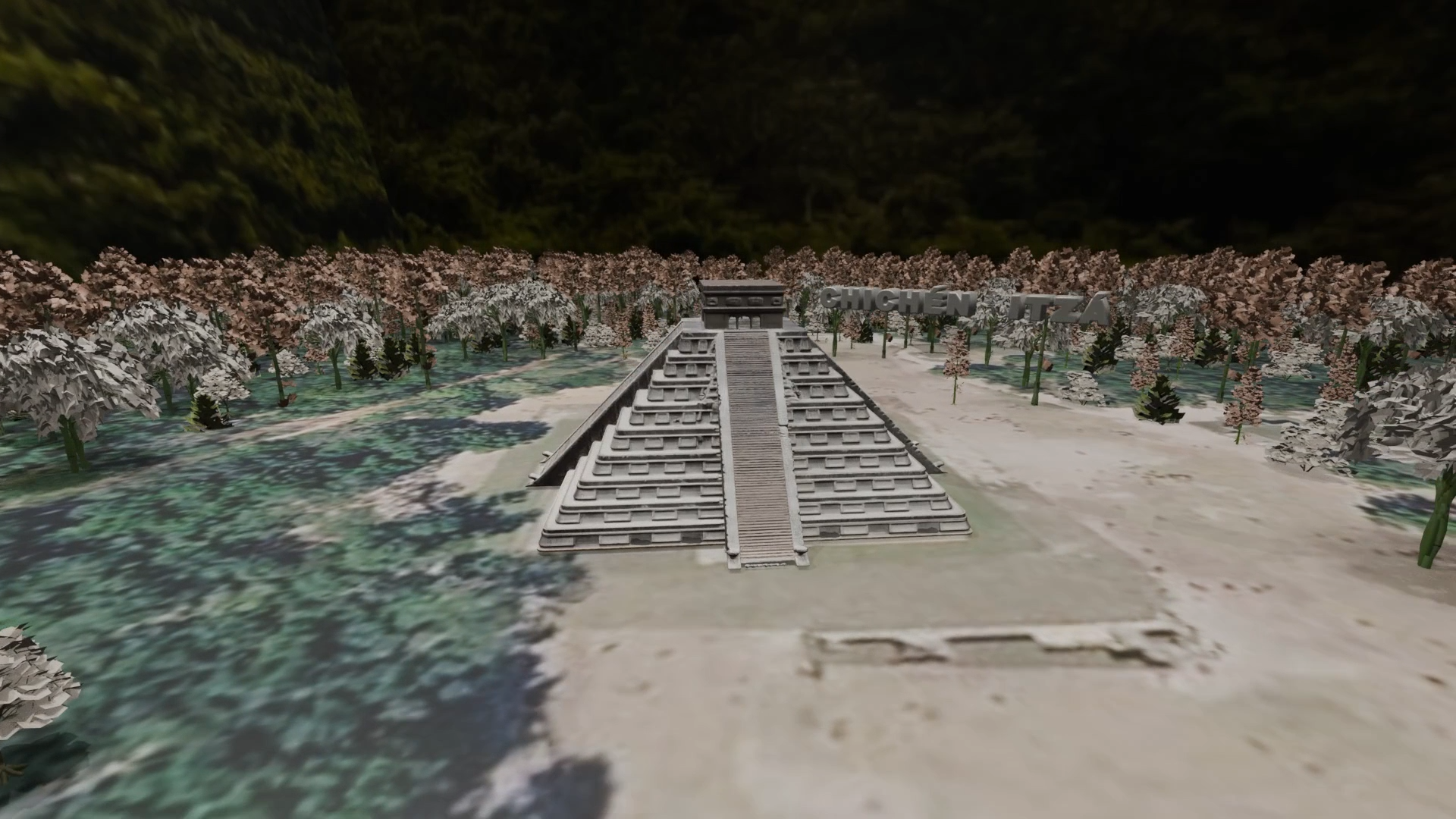
Name: Chichén Itzá Coordinate: 20.6843° N, 88.5678° W Height: 24 meters Width: 55x55 meters Year: 900-1200 AD
Name: Chichén Itzá Coordinate: 20.6843° N, 88.5678° W Height: 24 meters Width: 55x55 meters Year: 900-1200 AD
Chichén Itzá The archaeological site of Chichén Itzá is one of the most important cities of the Mayan civilization. The most famous monument is the Temple of Kukulcán, also known as "El Castillo," a large step pyramid that has become a symbol of Mayan culture and one of the New Seven Wonders of the World.
Description From a tourist perspective, Chichén Itzá is one of the most spectacular sites in Mexico. The site attracts millions of visitors each year thanks to its extraordinary Mayan architecture, monumental pyramids, carved temples, and sacred cenotes. The easiest way to reach it is from the cities of Cancún, Mérida, or Valladolid. Tour buses, organized excursions, and well-developed road connections are available. From Cancún, the journey takes about 2.5 hours, while from Mérida, about 1.5 hours. Within the site, you can also visit the Great Ball Court, the Temple of the Warriors, the astronomical observatory known as Caracol, and the Sacred Cenote. During the spring and autumn equinoxes, sunlight casts a shadow on the pyramid steps resembling a moving serpent: an astronomical phenomenon reminiscent of the god Kukulcan. Today, it is no longer possible to climb the pyramid for conservation and safety reasons, but the site remains one of the most fascinating examples of Mayan engineering and astronomy. (Maya Explorer Tour)
History Chichén Itzá was one of the greatest political, religious, and commercial centers of the Mayan civilization between the 6th and 13th centuries AD. Its name likely means "at the mouth of the well of the Itzas," a reference to the natural cenotes in the area, which were crucial for water supplies and religious rituals. (Encyclopedia of World History) The city began to develop during the Mayan Classic period, but reached its peak between 900 and 1200 AD. During this period, it became a very important cultural and commercial center of the Yucatán Peninsula. Scholars believe that Chichén Itzá was strongly influenced by the Toltecs, a people from central Mexico. This cultural fusion is visible in the site's art and architecture, where Mayan elements blend with typical Toltec warrior symbols. (Encyclopedia of World History) The Temple of Kukulcán represented the religious heart of the city. The pyramid was built with advanced mathematical and astronomical knowledge: its 365 steps symbolize the days of the Mayan solar year. During the equinoxes, the play of light and shadow on the north stairway creates the illusion of a feathered serpent descending from the pyramid, linking the monument to the cult of the god Kukulcán. (Encyclopedia Britannica) Archaeologists have discovered that older structures exist within the pyramid, built one atop another over the centuries. In an internal chamber, a jade-decorated jaguar-shaped throne and ritual statues called Chac Mool were found. (Encyclopedia Britannica) The city began to decline around the 13th century for reasons that are still unclear: internal wars, political crises, climate change, and the loss of commercial control likely contributed to the site's progressive abandonment. When the Spanish arrived in the Yucatán in the 16th century, Chichén Itzá was already largely deserted, but it continued to hold strong religious significance for the local population. (Encyclopedia of World History) In the 19th and 20th centuries, the site was rediscovered and studied by archaeologists from around the world. Today, Chichén Itzá is a UNESCO World Heritage Site and is considered one of the most important archaeological sites on the planet. (UNESCO World Heritage Center)